COUTURE 2026 Confirmed What Luxury Jewelry Owners Already Know: Distinction Is the New Growth Strategy
At COUTURE 2026 in Las Vegas, the jewelry industry did not simply present new product. It presented a new commercial reality.
Fine jewelry is moving away from sameness. The brands that stood out at Wynn Las Vegas were not necessarily the loudest, largest, or most aggressively merchandised. They were the ones with a clear point of view: a recognizable design language, a story that could travel across channels, and a product universe strong enough to hold attention beyond the showcase floor.
For luxury brand owners and jewelry founders, that is the real lesson of COUTURE 2026. The market is not rewarding generic luxury. It is rewarding specificity.
Across the show, the strongest collections reflected a broader shift in consumer desire. Clients want pieces that feel personal, collectible, symbolic, and rare — but they also want jewelry that can live in the rhythm of their real lives. This explains the rise of corded necklaces, sculptural gold, colored gemstones, talismanic pendants, antique-inspired chains, dome rings, lariats, ear cuffs, and functional objects that blur the line between adornment and utility.
The most compelling brands understood that jewelry is no longer bought only for milestone occasions. It is bought for identity. For memory. For self-expression. For the private feeling of owning something that seems to have chosen you back.
Below, a report on the 25 jewelry brands to know from COUTURE 2026 — including several new names making their COUTURE debut — and the trends shaping the next chapter of luxury jewelry.
The Biggest Jewelry Trends From COUTURE 2026
1. Gold With Character
High-polish gold no longer has the room to itself. At COUTURE 2026, gold appeared more sculptural, matte, brushed, hammered, textured, and hand-felt. The shift matters commercially: when gold prices rise, design has to work harder. Texture, form, scale, and finish become part of the value proposition.
For jewelry brands, this is an opportunity. A simple gold piece is increasingly hard to justify at a luxury price point unless the surface, silhouette, or craftsmanship carries a story. Gold must now feel authored.

2. Colored Gemstones as Brand Language
Sapphires, emeralds, rubies, tourmalines, opals, citrines, aquamarines, turquoise, and yellow stones were not treated as accents. They were central to brand identity.
The strongest gemstone collections at COUTURE did not use color decoratively. They used it as a signature. This is an important distinction for founders: color can become a navigation system, a merchandising story, and a memory device for clients.
3. The Return of the Pendant
Pendants were everywhere — oversized, symbolic, playful, spiritual, sculptural, and deeply personal. Some were worn on gold chains; others were suspended from leather, velvet, rubber, or cord.
This movement reflects a larger change in how clients buy fine jewelry. A pendant is intimate, visible, and easy to layer. It can hold a story without requiring a full suite. For brands, it is also a powerful entry point into collectability.

4. Corded Necklaces and Casual Luxury
One of the clearest signals from COUTURE 2026 was the corded necklace. Fine jewelry is becoming less formal without becoming less valuable.
Leather, silk, velvet, rubber, and textile cords give high jewelry a more modern, wearable attitude. They also allow a brand to frame serious stones in a less expected way. The result feels less like safe investment dressing and more like a woman with a point of view.
5. Antique Chains, Reimagined
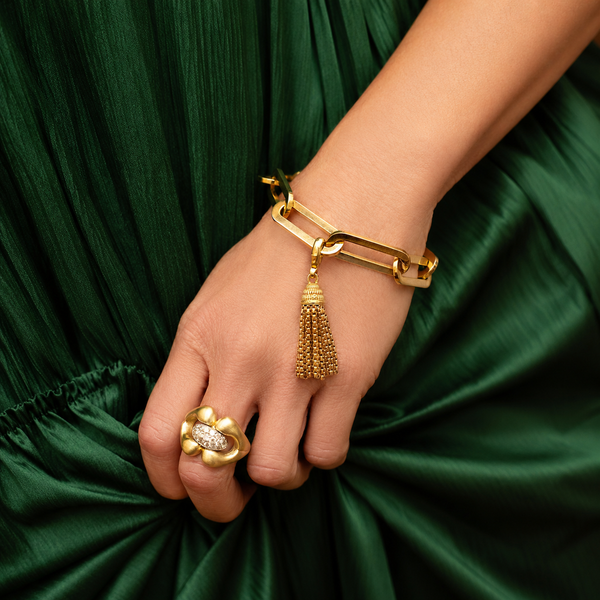
Paperclip links, trombone chains, curb chains, mariner links, watch-fob-inspired silhouettes, and Victorian references returned with force. But the mood was not nostalgic reproduction. The best examples were edited, weighty, polished, and modern.
For luxury jewelry brands, the chain is no longer a supporting category. It is a hero product. It can carry pendants, charms, talismans, and identity — and it gives clients a reason to build over time.
6. Collars, Torques, and Neck Jewelry With Presence
Chokers, collars, and torques continued to gain momentum. These pieces read as wearable architecture: less delicate, more decisive.
They also photograph exceptionally well, which matters in an era where jewelry discovery happens across Instagram, editorial, AI search, and retailer feeds. Strong silhouettes are not just design choices. They are visibility strategies.

7. Dome Rings and Sculptural Volume
The dome ring is becoming a modern luxury staple. Its appeal is obvious: it is bold without being costume, sculptural without being unwearable, and highly recognizable on the hand.
The best versions use stones, pavé, mixed metals, or unusual surfaces to add depth. For brand owners, dome rings are a reminder that volume and simplicity can coexist when proportion is right.
8. Lariats and Movement
Lariats offered a softer alternative to the structured choker and the traditional pendant necklace. They introduce line, length, and motion.
This is a particularly strong category for brands that want to sell versatility. A lariat can feel sensual, modern, and practical at once — worn over skin, silk, tailoring, or eveningwear.
9. Shoulder-Dusting Earrings
Earrings became longer, more expressive, and more editorial. The best shoulder-grazing pieces were not simply long; they had rhythm.
For luxury jewelry brands, this points to a broader merchandising opportunity. Clients are looking for pieces that transform the face and photograph with impact. Earrings are becoming a styling category, not just a finishing touch.
10. Whimsy, But Made Precious
Popsicles, shells, sea life, sunglasses, cowboy boots, hats, flowers, and talismanic symbols appeared throughout the show. But the reason they worked was material discipline.
Whimsy in fine jewelry only succeeds when it is executed with serious craftsmanship. Otherwise, it becomes novelty. At COUTURE 2026, the best playful pieces had enough preciousness, detail, and finish to make them collectible.
11. Western and Americana References
Western motifs — horseshoes, belt buckles, arrows, cowboy boots, bandana references, turquoise, and rodeo codes — appeared in several collections. This was not costume western. It was Americana translated through gold, enamel, diamonds, and stone.
For jewelry brands, this is a case study in cultural timing. When a motif is already moving through fashion, interiors, and media, jewelry can interpret it in a way that feels more enduring.
12. Jewelry as Object
One of the most interesting movements was jewelry that does something: compact mirrors, lockets, vessels, modular charms, interactive pendants, and pieces that hold, conceal, or transform.
This is the future of collectability. Clients want more than decoration. They want a reason to return to the piece — to open it, layer it, customize it, or attach meaning to it.
The Top 25 Jewelry Brands to Know From COUTURE 2026
1. Boghossian
Website: https://www.boghossianjewels.com
Why it matters: A family-run Swiss maison with roots tracing back to the Silk Road, Boghossian brings heritage, gemstones, and technical innovation into one highly refined universe. Its COUTURE debut underscores a larger movement toward maisons that can speak fluently about both old-world craft and contemporary engineering.
For luxury founders, Boghossian is a lesson in lineage. The brand does not rely on heritage as decoration; it uses heritage as structure.
2. Crisscut
Website: https://www.crisscut.com
Why it matters: Built around patented diamond cutting, Crisscut occupies an interesting position in the luxury jewelry market: technical differentiation that is visible to the consumer. Its story is not simply that the stones are beautiful, but that the beauty is engineered through a proprietary approach.
For brand owners, this is the power of owning a product signature. A recognizable cut can become both an aesthetic and a commercial moat.
3. Edina Kiss
Website: https://www.edinakiss.com
Why it matters: Edina Kiss brings a playful but elevated spirit to fine jewelry, working with 18k gold, sapphires, tourmalines, aquamarine, agate, and unexpected materials. The brand’s appeal lies in its ability to be serious about craft without becoming overly formal.
This is an important modern luxury formula: fine jewelry with wit, personality, and a human hand.
4. Futura Jewelry
Website: https://www.futurajewelry.com
Why it matters: Futura’s positioning around certified ecological gold gives it a distinct voice in a market still negotiating the relationship between luxury and responsibility. Its work draws from historical design while centering material ethics.
For jewelry founders, Futura shows that sustainability cannot be a footnote. When done well, it becomes part of the brand’s creative authority.
5. Ashna Mehta
Website: https://ashnamehta.com
Why it matters: Ashna Mehta’s Bag Bijoux concept introduces a fresh category: jewels designed for bags. This is commercially significant because it extends fine jewelry beyond the body and into the broader luxury accessories ecosystem.
The idea is timely. As handbags remain one of luxury’s strongest status categories, jewelry that interacts with bags opens a new path for personalization and collectability.
6. BAETYL Jewelry
Website: https://baetyljewelry.com
Why it matters: BAETYL’s emphasis on rare stones and one-of-a-kind design aligns with a growing client appetite for jewelry that cannot be easily repeated. The brand speaks to collectors looking for natural beauty, individuality, and a sense of discovery.
For retailers and founders, BAETYL reflects a major opportunity: the client who wants “something no one else will have.”
7. Clara Chehab
Website: https://clarachehab.com
Why it matters: Clara Chehab’s work sits at the intersection of raw stones, femininity, and emotional design. Her brand language is rooted in contrast: strength and softness, roughness and fluidity, power and intimacy.
This is the kind of storytelling jewelry owners should study. The product has a clear emotional world, which makes it easier to translate into editorial, retail, and digital experiences.
8. Cultus Artem
Website: https://cultusartem.com
Why it matters: Cultus Artem approaches jewelry through a sensorial lens, connecting rare materials, time-intensive technique, fragrance, beauty, and object-making. The result is a brand universe rather than a narrow product line.
For luxury founders, Cultus Artem demonstrates the value of world-building. Jewelry becomes part of a broader language of material, ritual, and atmosphere.
9. Daniel Yu Jewelry
Website: https://www.danielyujewelry.com
Why it matters: Daniel Yu’s architectural background informs a design process rooted in form, geometry, proportion, and 3D construction. The brand’s custom orientation also speaks to one of the strongest commercial shifts in luxury jewelry: clients want to participate in the making of meaning.
This is not customization as a dropdown menu. It is collaboration as luxury.
10. İTÄ
Website: https://www.itajewelry.com
Why it matters: İTÄ is built on dialogue across cultures, with creative roots between Istanbul and San Juan. Its work reflects symbols, rituals, friendship, and cross-cultural exchange.
The brand’s momentum at COUTURE matters because jewelry clients are increasingly drawn to pieces that feel globally literate — not generic, but shaped by place, memory, and personal history.
11. Shola Branson
Website: https://sholabranson.com
Why it matters: Shola Branson’s work explores ritual, architecture, permanence, and objects that feel outside of time. The brand’s design language is quiet, weighty, and intellectual.
For jewelry brand owners, this is a reminder that luxury does not always need to seduce quickly. Some of the strongest brands create desire through slowness, discipline, and depth.
12. U Los Angeles
Website: https://www.ulosangeles.com
Why it matters: U Los Angeles brings a modern West Coast perspective to fine jewelry, with an emphasis on individuality, self-expression, and day-to-evening wearability. The brand reads as polished but not rigid.
This is commercially relevant because the modern luxury client wants jewelry that can move through her life. She is not saving everything for a gala.
13. Anita Ko
Website: https://anitako.com
Why it matters: Anita Ko continues to represent the power of sleek, modern, highly wearable fine jewelry. The brand’s pieces are recognizable without being overdesigned, which has helped it sit comfortably between celebrity visibility and everyday luxury.
For jewelry founders, Anita Ko is a case study in restraint. The product feels desirable because it understands proportion, polish, and the modern woman’s wardrobe.
14. Stoned Fine Jewelry
Website: https://www.instagram.com/stonedfinejewelry/
Status: Emerging / Independent Fine Jewelry Brand
Why it matters: Stoned Fine Jewelry brings a more intimate, modern collector’s energy to the category, with a focus on pieces that feel personal rather than overly commercial. Its presence in this report speaks to a larger shift in fine jewelry: clients are increasingly drawn to brands with personality, specificity, and a strong visual point of view.
For jewelry founders, Stoned is a useful example of how an independent brand can build desire through curation, tone, and distinct identity — even before it has the scale or visibility of a heritage house.
15. Harwell Godfrey
Website: https://harwellgodfrey.com
Why it matters: Harwell Godfrey continues to lead with symbolism, saturated color, geometric patterning, and talismanic design. Its western and protective motifs felt especially aligned with the broader COUTURE mood.
The brand is a strong example of how to build a visual vocabulary. Once a client understands the codes, every new piece feels like part of a larger world.
16. Marie Lichtenberg
Website: https://marielichtenberg.com
Why it matters: Marie Lichtenberg has built a powerful universe around lockets, cords, scapulars, charms, and sentimental objects. At a moment when pendants and corded necklaces are surging, the brand’s language feels particularly relevant.
Its strength lies in emotional collectability. The pieces feel personal before they even belong to the client.
17. Chiarelli Milano
Website: https://chiarellimilano.com/
Why it matters: Chiarelli Milano brings an Italian point of view to fine jewelry, with a visual language that feels polished, feminine, and highly refined. In a COUTURE landscape shaped by color, sculptural gold, and jewelry with stronger personality, the brand feels aligned with the market’s move toward pieces that are elegant but not anonymous.
For luxury jewelry founders, Chiarelli Milano is a reminder that Italian fine jewelry still carries powerful commercial authority — especially when the design codes feel distinctive enough to travel across social, editorial, and retail channels.
18. Retrouvaí
Website: https://www.mikimotoamerica.com
Why it matters: Mikimoto continues to define the pearl category while keeping it relevant to contemporary luxury. As pearls evolve beyond tradition into more sculptural and modern expressions, Mikimoto’s authority remains difficult to challenge.
The lesson is category ownership. When a brand becomes synonymous with a material, every trend cycle has to pass through it.
19. Fernando Jorge
Website: https://fernandojorge.co.uk
Why it matters: Fernando Jorge’s work is known for sensual form, fluid gold, and a distinctly Brazilian sense of movement. His jewelry often feels sculpted around the body rather than placed on it.
For founders, the brand is proof that national and cultural identity can inform design without becoming literal. The pieces carry place through shape, energy, and proportion.
20. Silvia Furmanovich
Website: https://www.silviafurmanovich.com
Why it matters: Silvia Furmanovich sits at the intersection of jewelry, craft, art, and decorative object. Her use of marquetry, wood, color, and global craft traditions continues to make her one of the most distinctive voices in high jewelry.
For brand owners, the takeaway is the power of technique as storytelling. When the process is extraordinary, the product gains editorial gravity.
21. Jade Trau
Website: https://jadetrau.com
Why it matters: Jade Trau’s diamonds are designed for real life, but never feel ordinary. Her work with chains, vintage-inspired links, and refined diamond silhouettes aligns with the larger movement toward everyday heirlooms.
This is a strong commercial position: diamond jewelry that does not wait for permission or occasion.
22. Yvonne Léon
Website: https://yvonneleon.com
Why it matters: Yvonne Léon brings a Parisian sense of charm, wit, and transformation to fine jewelry. Her work often plays with personalization, modularity, and unexpected details.
In the context of COUTURE 2026, that matters because clients are increasingly interested in jewelry that can shift, move, open, close, or become part of a personal system.
23. Ten Thousand Things
Website: https://www.tenthousandthingsnyc.com
Why it matters: Ten Thousand Things remains one of the most quietly influential New York jewelry brands, known for organic forms, modern restraint, and a hand-made sensibility. Its long, artful earrings fit the season’s interest in shoulder-grazing silhouettes.
The brand shows how minimalism can still feel emotional when the hand of the maker is visible.
24. Phillips House
Website: https://phillipshouse.com
Status: Established Brand / Exhibea Client
Why it matters: Phillips House brings a polished, modern sensibility to fine jewelry, with pieces designed to feel refined, wearable, and emotionally resonant. As an Exhibea client, the brand also represents the kind of luxury jewelry house investing in a stronger digital presence — one where product, storytelling, and commerce work together.
For jewelry brand owners, Phillips House is a reminder that growth today is not only about collection development. It is about building a digital experience that can translate craftsmanship, trust, and brand desire at every touchpoint.
25. Beck Jewels
Website: https://beckjewels.com
Why it matters: Beck Jewels stood out in the trend conversation around corded necklaces, beads, shell references, and summer-inflected fine jewelry. The brand brings a relaxed but intentional sensibility to the category.
This is a smart direction for modern luxury: pieces that feel collected, traveled, and personal, without losing preciousness.
What COUTURE 2026 Means for Jewelry Brand Owners
1. Your Brand Codes Matter More Than Your Product Count
The strongest brands at COUTURE 2026 did not need endless assortment to be memorable. They needed recognizable codes.
A code can be a stone palette, a chain link, a setting style, a finish, a motif, a clasp, a cut, a proportion, or a way of photographing the product. What matters is repetition with variation. Luxury clients need to recognize you before they remember your name.
2. Storytelling Is No Longer Optional
The brands gaining attention are not only making beautiful things. They are giving buyers, editors, retailers, and clients language.
A jewelry brand should be able to explain why a piece exists, what world it belongs to, how it is made, and why it matters now. This does not mean over-explaining. It means creating a strong enough narrative that the product can travel through press, retail, social, AI search, and the website without losing its meaning.
3. The Website Has to Work Harder
For many jewelry brands, the product is exquisite and the digital experience is underdeveloped. That gap is becoming more costly.
The modern luxury jewelry website must do more than show product grids. It needs to build desire, explain materials, show scale, guide discovery, support collectors, educate clients, capture inquiries, and make the world of the brand feel immediate. Especially for high-consideration jewelry, the website is no longer just commerce. It is client development.
4. AI Search Will Favor Clear Authority
As AI search becomes more important, jewelry brands need content that is structured, specific, and authoritative. A brand that clearly explains its materials, founders, craftsmanship, collections, gemstones, sustainability, origin story, press, and stockists will be easier for AI systems to understand and recommend.
This is where many luxury brands are currently vulnerable. Beautiful but vague copy does not perform well in AI discovery. The future belongs to brands that can be poetic and precise.
5. Collectability Is the New Conversion Strategy
The most commercially intelligent brands are building reasons for clients to return: charms, pendants, cords, chains, modular pieces, birthstones, talismans, lockets, one-of-a-kind stones, limited drops, and custom commissions.
The goal is not only one purchase. It is a relationship. The client should feel that buying one piece begins a collection.
Final Takeaway
COUTURE 2026 made one thing clear: the future of fine jewelry belongs to brands with a point of view.
The next generation of luxury jewelry will not be defined by minimalism alone, nor by maximalism for its own sake. It will be defined by meaning, materiality, craft, and distinction. Gold will have more texture. Stones will carry more color. Pendants will become more personal. Chains will become more collectible. Objects will become more functional. And emerging designers will continue to challenge the boundaries of what jewelry can be.
For jewelry founders and luxury brand owners, the message is direct: make the product unmistakable, make the story ownable, and make the digital experience worthy of the work.
Because in a market crowded with beauty, the brands that endure are the ones that give clients something to remember.
Need a Luxury Jewelry Website Built With the Same Level of Care as Your Collection?
For fine jewelry brands, the website is no longer just a storefront. It is where clients discover the world of the brand, understand the craftsmanship, build trust, and decide whether a piece feels worthy of investment.
At Exhibea, we design and develop elevated Shopify and Shopify Plus experiences for luxury jewelry, fashion, beauty, and lifestyle brands — bringing together refined creative direction, conversion strategy, and the technical foundation needed to scale.
If you are a luxury jewelry brand ready to build a digital flagship that reflects the value of your work, contact Exhibea.